Upload vs download
The two main speeds that you’ll be presented with are Upload and Download speeds, which both impact a different aspect of your broadband experience, so it’s important to know exactly what you’re dealing with.
Broadband speeds are one of the most important technical aspects of a broadband package - they can often be one of the main deciding factors in choosing a particular package, or can be the reason you’re looking to change providers if you are experiencing below-par performance. If you’re struggling to come to terms with what all of the different speeds mean in terms of your broadband, we’re here to offer a helping hand! Below you can find our jargon-free breakdown on broadband speeds.
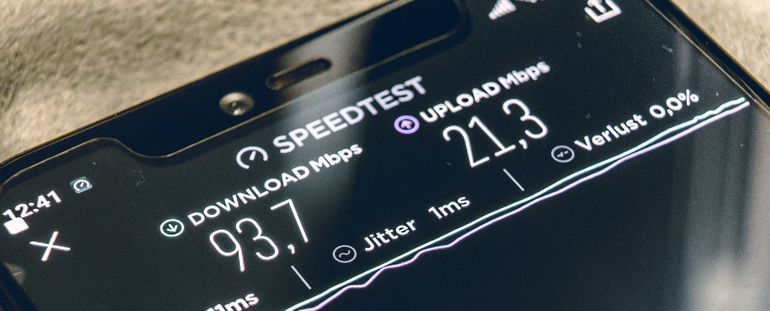
The two main speeds that you’ll be presented with are Upload and Download speeds, which both impact a different aspect of your broadband experience, so it’s important to know exactly what you’re dealing with.
Your download speed is measured in Mbps (megabits per second) and dictates how fast you can pull data from a server to your devices, essentially impacting how fast and efficient your browsing experience is. Think of your download speed as the number that impacts how quickly you can access data that aren’t already yours and needs to be obtained - streaming movies, browsing your social media, listening to music, and even loading web pages will all be reliant on your download speed. Most broadband packages are designed to optimise download speeds so that they’re much faster than upload speeds as the majority of online activity operates using the downloading of data rather than uploading.
Alternatively, upload speeds are how fast you are able to send data from yourself to others - this is when you’re performing tasks such as sending files in emails, video calls with friends and family, as well as streaming your gaming experience through platforms such as Twitch. This speed is also measured in Mbps, but don’t be too surprised to see a significant difference between your upload speed and your download speed - it’s designed that way to optimise your experience.
Your advertised and typical speeds are the speeds that you can expect to experience at peak times, as provided by your broadband supplier. These speeds are deciphered by finding the advertised speed experienced by at least 50% of customers at peak times, so you can be fairly confident that this speed will be somewhat accurate to what you’ll receive. If your actual speeds are significantly lower than this, your provider has 30 days to rectify this poor performance or you will be able to leave your contract for free as stated by the Voluntary Code of Practice on Broadband Speed.
There are different levels when it comes to broadband packages, and each provides a different level of speed to the user. The main different packages you’ll find are as follows:
If you’re noticing that your speeds are regularly much lower than you’d expect from your broadband package, there are a few tricks that you can try to help optimise performance within your home; these aren’t guaranteed to work, but usually do boost speeds a little bit.
For more info on how to boost your broadband speeds, check out this post!
To test your broadband speed, make sure your device is connected to your broadband then head over to your preferred speed test website or app - www.speedtest.net is a popular choice that’s free to use. Simply click go and you’ll be given a breakdown of your speeds at that time.
Upload and download speeds aren’t the only thing that impacts your performance - there are other stats to look at that may be impacting how well your broadband can perform. Ping is your broadband connection’s reaction time, essentially recording how fast you get a response after sending a request to a server. If your ping score is fast, it means that you have a responsive connection. This is particularly important when working in scenarios where timing is important, such as online gaming. You may also see ping referred to as ‘latency’ - don’t worry, they’re the same thing.
Network volume may also impact how effective your broadband performance is. The more devices are active on the network at a time, the more stretched your bandwidth becomes, resulting in slower speeds for all. There are a few ways around this, including prioritising devices so that some carry more weight when distributing bandwidth, changing network channels, or upgrading to a package that offers greater bandwidth.
This is when your speeds are intentionally slowed down by your internet service provider - it’s a reactive measure taken to attempt to regulate traffic on a network so that bandwidth congestion is minimised. Many providers take part in this process, resulting in customers experiencing less than optimal performance at peak times. Zen has a no-throttling policy that ensures that all of our customers are given the best quality broadband connections at all times.
Reliable fibre broadband that's ideal for everyday browsing, streaming and working from home.
Our fastest broadband, perfect for busy homes with lots of connected devices.

With Zen EveryRoom you will experience more reliable WiFi that adapts to your needs, providing the strongest signal whatever room you're in allowing you to roam without experiencing dropped connections.